The Great Family Fire
By Caroline Thompson
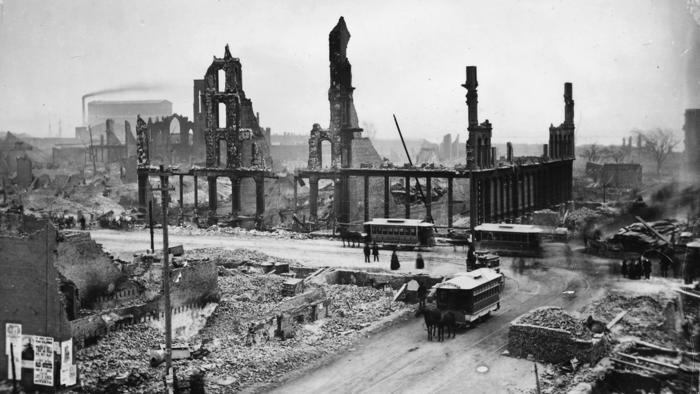
The pictures are haunting. The river is frozen around the charred stumps of what was, just a few months before, a well-travelled bridge. Across the ice lie the ruins of factories. The pointed shards of partially collapsed buildings teeter hundreds of feet into the air, a sinister mountain range born of fire and death. Some of these pieces of wall are still supporting windows with sharp, broken glass clinging to their corners. Through these windows, the dismal view continues. Leafless, lifeless trees, dark as night, stand straight at attention or lie still on the seared black ground. Though the fire that destroyed this place is months gone, a misty, smoke-like haze seems to have settled over the remains of the city.
I made my first trip to Chicago 126 years after these pictures were taken. It was 1997, and I was just a kid. My parents and I were driving from Minneapolis to see my grandparents in Oberlin, Ohio. We stayed at a hotel on the river, not far from the site of those old fire photographs. I remember pushing my face right up to the glass window that made up the back wall of our room. It was a gray day, but not foggy. The buildings that rose from the brown water were whole, alive. They seemed to stretch forever into the sky, seemed more like accidentally symmetrical cliffs and mountains than the carefully plotted creations of men. Then as now I felt the weight of the city, the power, the sheer size. It was incomprehensible. It was intoxicating.
Sometimes when I’m feeling nostalgic I’ll take a walk downtown pretending I’ve been transported from the past. I’ll wander the once-charred streets and stare open-mouthed at towering glass buildings reflecting the water and sky, the shiny, brightly colored metal carriages that speed past with reckless abandon, the people walking with purpose, dressed in an infinite array of colors, talking to themselves or lost in contemplation, hypnotized by the light bouncing off the glassy rectangles clutched in their sweaty hands.
So much about the city is new, so much is changing before us every day, and yet it can be hard to recognize progress when it happens. Looking at the skyline on any given day, it’s difficult to imagine it wasn’t always there. But it wasn’t. The time traveler in me imagines this city must have taken millenniums to erect, imagines it will stay unchanged and indestructible for millenniums to come. And yet the city is less than 200 years old. It’s strange how easily we forget. How after every addition to the lake front’s imposing skyline is planned, raised, perfected and filled with condos or cubicles, we accept it into our vision of the past. It’s always been there, even if we watched it being built.
There are places in the world where this feeling of forever can be justified. Rome, for example, was founded in 753 BC, and since then, countless empires, kings, palaces and governments have risen and fallen, thrived and disintegrated on the same ground, separated only by time and circumstance. You can walk the perimeter of the city’s infamous Coliseum and rest assured you’re following 2,000 years of human footsteps around the same structure. In modern-day Rome, it would be possible for my inner time traveler from, say, 237 AD, to recognize the ruins and reconstructions of landmarks from the city she knew.
Today’s Chicago, with its buildings in the clouds, its winding river and blue, wavy lakefront packed with skyscrapers of every conceivable architectural style, has no such long-standing history with the human race. But the city’s history, though lacking the scale of so many ancient settlements, is perhaps equally remarkable. Because Chicago rose to greatness from nothing. Not once, but twice.
***
Just before midnight on Sunday, October 8th, 1871, my great-great-great-great grandfather, Roswell B. Mason, was roused from his slumber at his home on Michigan Avenue by a man on horseback bearing news of a fire that had enveloped the city. According to a biography of Mason published by the Chicago Historical Society, the man galloped up to the Masons’ house and called up to the sleeping man’s window, “Mayor! Come give orders to save the city!”
It was the second fire in less than 24 hours. The first began at a planing mill, which stood between Jackson and Van Buran on Canal Street. It broke out at midnight on Saturday, October 7th, and raged for nearly 16 hours. When flames were finally quelled, they had devoured four city blocks and exhausted nearly all the resources the Chicago Fire Department had on hand. The entire department had been called out for the job. After nearly a full day of battle, the firemen stumbled home to their wives and children covered in soot and sweat, in desperate need of a good night’s sleep. But the fire wasn’t finished. Just hours later, around 9-o’clock on Sunday, these soldiers of the fire were once again shaken awake, and this time, the fire won the war.
There is a considerable amount of mythology around the Great Chicago Fire. Maybe, like the old stories say, Mrs. O’Leary left a lantern in her little barn on DeKoven Street. Maybe her cow knocked it over as it settled into the hay for the evening. Maybe one Peg Leg Sullivan saw the flames from across the street and hobbled over on his wooden foot to save the animals trapped inside the barn. The city of Chicago officially exonerated Mrs. O’Leary in 1997, 102 years after her death, but the legend still remains.
However the fire started, it spread quickly, happily feasting on wooden houses and storefronts, fueled by the cracked, dry ground littered with crispy brown leaves, the product of a hot, three-month drought. The firemen fought gallantly, but after the previous night’s efforts, few of them were up to the job. To make matters worse, the mill fire had destroyed much of the equipment needed to combat this new blaze, including a few of the department’s newly acquired steam pump fire engines, which were pulled along by horses. The exhausted firemen had to abandon the fight at Chicago and Michigan Avenue, when it became clear that continuing the battle would mean certain death.
Mason was in his final months as mayor, elected by a city with a growing revulsion to the rampant corruption and immorality plaguing its streets. It was, according to Herman Kogan and Llyod Wendt in their book, Chicago, a Pictorial History, “a time of easy morals and easy money,” gambling saloons, brothels and crooked councilmen were popping up everywhere. But Mason was well liked by both his constituents and the press. He was generally thought of as a moral and dedicated family man, referred to by the Chicago Tribune as “an honest man presiding over a den of thieves.”
I grew up hearing the story of his life over and over, as did my mother and my aunts before me, and my grandmother before them. In our family, the name Roswell Mason is sacred, a link to the past, a reminder of the possibilities afforded us by our lineage. In our collective family mind, he was a self-made man, an example of a true American hero. His name is always uttered in the same breath as his title and place in history: “Roswell B. Mason, mayor of Chicago during the Great Chicago Fire.”
But before the fire in 1871, before he took office in 1869, before he was appointed chief railroad engineer of the Illinois Central Railroad, before he decided to add the “B” in between his first and last names as a symbol of authority, Roswell Mason was a child, and a sickly one at that. A biographical record of his life written by his son, Henry B. Mason, tells that Roswell’s early life was plagued with illness. Modern germ theory was in its infancy in the early 19th century, and his parents believed the best way to improve their son’s feeble health was through a strictly regimented diet. His earliest memories were thus plagued with deprivation. He wanted food he was not allowed to have, craved the taste and texture of the sweets that were not, under any circumstances, to pass his lips.
His father was a well-to-do farmer and contractor, and though his health was poor, Roswell spent his summers working on the farm. In 1821, the 17-year-old Roswell accompanied his father on a canal contracting job in Albany. All summer, the teenager helped his father haul stone to build a lock near the Erie Canal, and as a result he landed a job on a canal engineering team. He quickly rose up through the ranks, eventually attending an elite engineering school in Utica and returning to a job as a railroad engineer.
According to a few family biographers, in 1825, Roswell was hard at work as the principal assistant engineer on the Morris Canal, near the town of Parsippany, N.Y. Often he and a few other young engineers would spend the night at the home of Royal Hopkins, a Parsippany contractor with a beautiful daughter who caught Roswell’s eye.
Harriet Lavinia met the young engineer during a dinner at her father’s house. She later told her children her first impressions of Roswell left her thinking: “You are a very nice young man, but I shouldn’t like to marry you,” perhaps because the whole romance was quite convenient for him. Her house was on the very road he needed to travel to work on the canal, and family lore says she often lamented how easily he won her.
By this time, Roswell had outgrown his childhood weakness, and was, by his own recollection, sporting an active build and a devilish grin. Every morning, dressed in a smart coat of Lincoln green, Roswell would ride his trusty horse, Robin, up to the Hopkins’ gate, and Harriet would run outside and give the horse a gentle pat and the rider a kiss. Perhaps her love didn’t take much strife to win, but as her son, Henry B. Mason, recalled in his speech at the couple’s 50th anniversary party in 1881: “She insists that he secured her with too little trouble, but adds that she has given him trouble enough since that time.”
And so the two were married on a sunny September day in 1831. Harriet was 23. Roswell was 25. Roswell and Harriet moved around a great deal during the first few years of their marriage: New Milford, Connecticut, Jersey City, New Jersey, Williamsburg, Pennsylvania. Today, a commute between these east coast cities would take no more than a few hours by car, bus, train or plane, but the Masons spent days in their stagecoach, plugging along rocky new roads in this rocky new country.
By 1865, the Masons had settled in Chicago. That year, Roswell was one of the four top engineers in charge of cleaning up the Chicago River. They deepened the Illinois and Michigan Canal, established pumping works at Bridgeport and lowered the summit of the canal to reverse the river so it flowed into the Illinois River. Today’s beachgoers can thank Mason for their leisurely, cholera-free swims in Lake Michigan.
Four years after the river cleanup, in 1869, Mason was elected Mayor of Chicago.
***
At the time of the fire, Chicago was young. A fledgling city in a fledgling country, one of many such great American experiments. In the grand scheme of things, detailed records of Chicago’s history don’t go back very far. Members of the Hopewell Tradition, an ancient network of Native American societies, lived on Lake Michigan starting from about 200 BC. The Hopewell culture was made up of farmers, fishermen, traders and artists. They buried their dead in elaborately constructed mounds, outfitting the corpses with the fruits of their expansive trade network: shell cups from the Gulf of Mexico, handmade freshwater pearl necklaces from the Mississippi River Valley. Some of these mounds still stand today in southwestern Illinois, monuments to this mysterious ancient culture, forgotten by time and discounted by many European historians.
Descendants of the Hopewell Tradition became the Miamis, the Weas, the Illinois and the Pottawatomies, who were happened on by early French explorers during the late 17th century. The name “Chicago” comes from a French interpretation of the Miami-Illinois word “chicagoua,” which described a particular kind of wild garlic that flourished in the heavily wooded forests around the lake. Today the city is made of asphalt and concrete, of iron and steel, but when Frenchman Henri Joutel jotted down a note in his journal describing early Chicago in 1687, few could have imagined the sprawling metropolis soon to inhabit this spot in the world.
But time sped forward. I imagine the founding of the city in fast motion: trader and first full-time Chicago resident Jean Baptiste Point DuSable and his family move like worker ants on amphetamines as they quickly build their homestead along the Chicago River in the late 18th century, and live out 20 years tending to the farm. The United States sends troops from Detroit to create an outpost in Illinois, and Fort Dearborn rises as if from nowhere on what is now the corner of Wacker Drive and Michigan Avenue. Log on log, the wooden fort is completed in 1804, and suddenly it’s 1812, and a war between Potawatomi natives and U.S. troops rages for a moment and then dies down, leaving nothing but the charred, smoking remains of the fort, scattered with the bodies of those slain in the battle.
And then, a city emerges. Not all at once, but in little bursts of cabins and barns and hotels and taverns. You can tell there was no plan at first, houses spring up haphazardly with no grid to guide the construction, but that soon changes. Streets are arranged in straight lines around the river, schools are built, children are born and grow up to have children of their own. Brick by brick, the once untamed wilderness surrounding the river is a small town of 200 in 1831. Look away for a moment, and when you look back, that small town is now home to 4,170 people who are granted a city charter and elect their first mayor, William B. Ogden, in 1837. When Mason was elected less than 40 years later, the city’s population had grown to nearly 300,000. It was busy, it was bustling, and it was made mostly of wood.
***
The night of the fire, after hearing the horseman’s call to action through his open window, Mason jumped on his own horse and raced to his office at City Hall, above the courthouse on the southwest corner of Clark and Randolph. By the time he arrived, the relentless flames were just starting to lick the sides of the building, but despite the danger, he ran inside and began firing off desperate telegrams to the nearby cities of Milwaukee, St. Louis, Cleveland and Detroit:
“Before morning one hundred thousand people will be without food or shelter. Can you help us?”
Soon after Mason’s arrival, at around one-o’clock in the morning, a strong, hot wind carried embers from the surrounding chaos to the top of the courthouse’s imposing wooden cupola. It burst into flames, sending a wave of thick black smoke down into the halls surrounding the mayor’s office and the courthouse jail that lay beneath City Hall.
According to eyewitness reports, a few bystanders heard the inmates screaming for help. They banged frantically on the bars which held them prisoner as the curling smoke filled their holding cells. In response to their cries, several people on the street began trying to free the prisoners by breaking a hole in the wall of the jail, but were thwarted in their rescue attempt by a county official, who coldly informed them that only the mayor could order the release of these men.
Upon hearing the plight of the prisoners trapped beneath him, Mason grabbed a sheet of Chicago Police stationary and, using a pencil, hastily scrawled out a proclamation:
“Release all prisoners from jail at once, keeping them in custody if possible.”
On his orders, a flock of frantic men were let out into the smoldering city streets. Although officers tried to keep the more dangerous criminals in custody, most of them escaped into the night. Family legend says Mason’s son tried to stop a burly man who was being held on a murder charge as he attempted to escape justice. But the mayor’s son was small in comparison to the prisoner, and he was knocked down with just one punch. The man ran off into the flames, never to be seen again.
Mason stayed at his office until just before the building’s bell tower came crumbling down in the early hours of the morning. Exhausted, disheartened and covered head to toe in soot, he made his way back home through the fire. On his way, he is said to have ordered the destruction of buildings of Wabash Avenue and Harrison Street, in order to prevent the fire from venturing any farther south or east. When he finally arrived at his house at 4:30 am, Harriet at first refused to let him in the door. His face and clothes were black with soot, and his hair and beard were disheveled and caked with sweat and dirt; Harriet looked upon her husband without recognition, seeing only a wandering vagrant. After a few minutes of cautious conversation, she realized her mistake and welcomed her husband back into their home, enfolding him in her arms with a burst of tears.
***
“THE GREAT CALAMITY OF THE AGE!” Screamed the headline on the front page of the Chicago Evening Journal-Extra on Monday, October 9. “The scene of ruin and devastation is beyond the power of words to describe. Never, in the history of the world, has such a scene of extended, terrible and complete destruction been recorded; and never has a more frightful scene of panic distress and horror been witnessed among a helpless, sorrowing and suffering population.”
At the time these words were written, around 1 p.m. on Monday afternoon, the city was still burning. Finally, around midnight on Tuesday morning, a soft but persistent rain began to fall, the first precipitation in three long months. It started as a light sprinkling, but soon erupted into a full storm. Drop after drop, the water crashed down onto the flames, hitting the embers that littered the singed ground with a hiss before evaporating into puffs of white steam.
The Chicago Historical Society has hundreds of letters written just after the fire by Chicagoans who survived the blaze. These letters include devastating descriptions of charred houses, lamentations for dead and missing friends and loved ones, and sad musings on the future of the ruined city. But nearly every one mentions the rain. A cleansing salvation. The rain poured on the smoldering city for nearly a full day. Try as they might, the flames could not survive the relentless downpour, and soon the charred city streets were slick and wet, scattered with the remains of the homes, businesses, and lives, taken so suddenly by the fire.
***
Mason’s efforts to save the city in the aftermath of the fire were nearly universally lauded in all the press clippings I could find from the era. He issued executive orders establishing the price of bread, banning smoking, and forbidding wagon drivers to charge more than their normal rates.
Family legend tells that after Illinois Governor John Palmer, a political rival of Mason’s, ignored the mayor’s requests to bring the National Guard to Chicago, Mason took matters into his own hands. He put the city under martial law, and issued a proclamation putting his friend, commanding general and Civil War hero Philip Sheridan, in charge. Sheridan brought in troops from the nearest military base to keep the peace in the city, and after several days with no serious disturbances, Mason lifted the martial law.
Two days after the fire, Mason issued a proclamation promising to restore order in the city, and in the following days, weeks and months, help arrived in droves. Men and money from surrounding cities poured in to assist in the cleanup and reconstruction. When corrupt members of City Council tried to gain control of this relief money, Mason stepped in to prevent the councilmembers from using these funds for their own personal gain. He turned over all contributions to the Chicago Relief and Aid Society, effectively halting the impending theft and jump-starting reconstruction projects.
For many Chicago residents, the idea that the city could survive this disaster was unfathomable. Lawyer Jonas Hutchinson, whose home and office at 86 Washington Street were burned to the ground, wrote a letter to his mother on October 9th expressing this sentiment:
“I cannot see any way to get along here. Thirty years of prosperity cannot restore us. It looks as though I must leave here & what to do I do not know.”
Yet somehow, within a matter of years, a new, imposing city of stone and brick rose from the ashes of its wooden predecessor. According to US Census data, in the decades prior, Chicago’s population was growing exponentially every ten years. The fire did nothing to curb this trend. By 1880, the city boasted a population of over 500,000, a rebuilt downtown and ever-expanding city limits. Hutchinson’s pessimistic predictions were proven wrong once and for all in 1893, when, just 23 years after the fire, hundreds of thousands of people from around the world poured into the city to take part in the Chicago World’s Fair. Hutchinson, surrounded in 1871 by the still-burning wreckage of his life, could not have known how quickly Chicago would bounce back. But the citizens, led by a courageous mayor, refused to let their city crumble into the void of history.
On the first anniversary of the fire, the Chicago-based real-estate magazine Land Owner published a collection of photographs, lithographs and drawings showcasing the impressive progress made in just a year.
“Our citizens have not been satisfied to simply replace the old city,” read a written piece alongside the pictures. “It has been their ambition to build it more beautiful and attractive than it was before it fell a victim to the resistless avalanche of fire.”
Mason’s term as mayor expired just two months after the fire. He was implored by many to run for re-election, but according to my cousin Manly Mumford’s self-published biographical booklet, The Old Family Fire, Mason “threw up his hands in horror over the prospect of serving again.” He was tired, and was perhaps spurred by the devastation he witnessed during the fire to spend more time with his family.
Mason died on January 1, 1892 at the ripe old age of 86, but his legacy lives on as the city he loved and led grows and changes with time. I'm not usually one to romanticize the past. I know as well as anyone that the "good old days" were only good for those who had the privilege of being born into the right bodies. But I find myself feeling uncharacteristically charitable to Mason's legacy.
The city I love, the city I live in today, is still a thriving metropolis, due in part to his efforts. Even in his darkest hour, Mason would not allow Chicago to sink into the ashes of obscurity.